
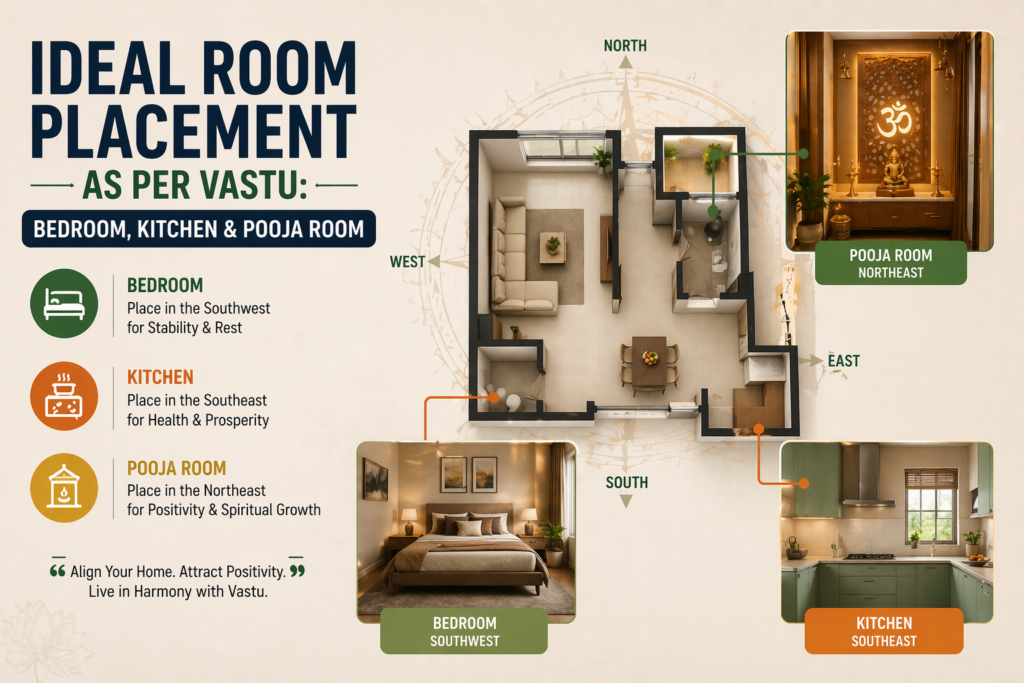
Vastu Shastra is an ancient Indian science of architecture that aligns a home’s layout with natural energies to promote health, prosperity, and peace. When planning your house, the placement of three key rooms—bedroom, kitchen, and pooja room—plays a central role in creating a balanced, harmonious living space. Below is a detailed blog‑style guide on how to position and design each of these rooms ideally, as per Vastu principles.
1. Bedroom Placement as per Vastu
Best direction for the bedroom
- The south‑west (SW) corner is considered the most stable and grounding sector of the house, making it ideal for the master bedroom.
- The south (S) zone is also suitable for adults’ bedrooms, especially when SW space is not available.
- Children’s bedrooms can be placed in the west (W) or north‑west (NW) zones, as these areas are associated with learning and growth.
Ideal bed placement and design
- Place the bed with the head towards the south or east, and avoid the head of the bed facing north, as traditional Vastu links this to disturbance in sleep and health.
- The bed should not touch the north or east walls directly; leave a small gap between the bed and the wall for better energy flow.
- Avoid placing the bed under a beam or directly opposite the main door, as this is said to create stress and low positivity.
General bedroom Vastu tips
- Keep the bedroom clutter‑free, well‑ventilated, and neatly organised to support restful sleep and mental clarity.
- Avoid placing heavy furniture, mirrors, or sharp‑cornered cupboards in front of the bed, as they can create “rajas” (restless) energy.
2. Kitchen Placement as per Vastu
Best direction for the kitchen
- The south‑east (SE) direction, known as the Agni Kona (fire corner), is considered the most auspicious for the kitchen because it aligns with the fire element.
- As an alternative, the north‑west (NW) zone can be used if SE is not feasible, but SE is always preferred.
Ideal stove and sink placement
- The cooking stove (gas hob) should be placed in the south‑east corner of the kitchen, and the person cooking should ideally face east while cooking.
- The sink, washing area, and water storage should be located in the north or north‑east part of the kitchen to balance the fire (stove) with water energies.
- Refrigerator and grain storage can be placed along the south or west walls, as these are considered “earth” zones.
Additional kitchen Vastu guidelines
- Avoid placing the kitchen directly opposite the main entrance or below‑above the pooja room or bedroom, as this can disturb the energy balance.
- Keep the kitchen clean, well‑lit, and free from clutter, and prefer light‑coloured, neutral tones for countertops and tiles to enhance positivity.
3. Pooja Room Placement as per Vastu
Best direction for the pooja room
- The north‑east (NE) corner, also called the Ishan Kona, is regarded as the most auspicious and spiritually powerful zone for a pooja room or mandir.
- This zone is governed by Jupiter (Guru), associated with wisdom, dharma, and divine blessings, and receives gentle morning sunlight, which is considered purifying.
Idol placement and prayer posture
- Place deities on a clean raised platform (pedestal) and avoid keeping idols directly on the floor.
- While praying, you should generally face east or north so that deities are aligned towards the north‑east.
- Avoid placing overhead cabinets or heavy shutters directly above the idols, as this can suppress spiritual energy.
Design and positioning tips
- The pooja room should not share a common wall with the bathroom or kitchen to maintain purity and positive vibration.
- Keep the space simple, uncluttered, and well‑ventilated, with a small cross‑ventilation or natural light but without harsh or direct harsh glare.
- Avoid locating the pooja room under stairs or in dark, closed corners, as this can block the flow of positive energy.
4. How Bedroom, Kitchen & Pooja Room Interact
Spatial relationship between the three rooms
- Ideally, the kitchen should not be directly above or below the pooja room or master bedroom, as the heat and sharp fire energy of the kitchen can disturb spiritual and rest spaces.
- The pooja room in the north‑east should be treated as a “quiet” zone, away from heavy traffic, loud appliances, and bathrooms.
Harmonising energies in a flat/home
- In compact flats, if a separate pooja room is not possible, you can dedicate a small north‑east corner of the living room or bedroom for the deity, keeping it clean and protected from dust and noise.
- Ensure proper ventilation and cross‑lighting across all three rooms so that one zone does not feel “heavy” or “stagnant” compared to the others.
5. Quick Vastu Summary Table (Bedroom, Kitchen, Pooja Room)
| Aspect | Ideal zone (Vastu) | Key practices |
| Master bedroom | South‑west (SW) | Head towards south/east; avoid north‑facing bed; keep room clutter‑free. |
| Children’s bedroom | West (W) or NW | Light colours; avoid overhead beams; keep study area in north/east. |
| Kitchen | South‑east (SE) | Stove in SE corner, face east while cooking; sink in north/NE. |
| Pooja room | North‑east (NE) | Idols on raised platform; face east/north while praying; no common wall with bathroom/kitchen. |
By aligning your bedroom, kitchen, and pooja room according to these Vastu guidelines, you can create a home that feels calm, nurturing, and energetically balanced. Even in small apartments, focusing on direction of the bed, stove, and idols plus keeping spaces clean and clutter‑free can make a noticeable difference in daily well‑being