
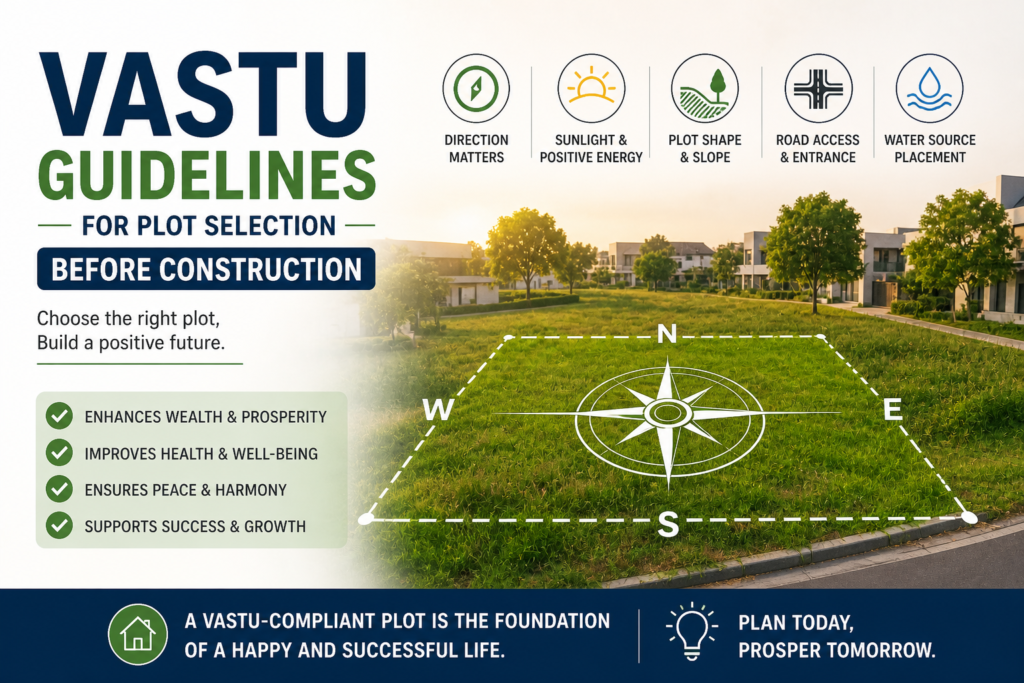
Choosing the right plot is the foundation of a harmonious home — literally and energetically. In Vastu Shastra, the ancient Indian science of architecture and spatial alignment, the land you build on is considered a living entity with its own energy field. Get the plot right, and everything built upon it is set up for prosperity, health, and happiness. Get it wrong, and even the most beautifully constructed home may carry invisible imbalances.
Whether you’re a firm believer or simply curious, understanding Vastu principles for plot selection can help you make a more informed, holistic decision before you break ground.
Why Plot Selection Matters in Vastu Shastra
In Vastu Shastra, the plot is treated as the foundation of all energy flow (known as prana). The land absorbs cosmic energies from the sun, moon, wind, and the Earth’s magnetic field. Its shape, slope, soil quality, and surroundings all determine how these energies circulate through your home and, ultimately, through your life.
Vastu experts often say: correct a Vastu defect in a building, but you can rarely correct the energy of the plot itself. This is why assessing the land before purchase and construction is considered even more critical than the house plan.
1. Ideal Shape of a Plot
The shape of your plot significantly influences the energy it holds.
Square plots are considered the most auspicious in Vastu. They represent perfect balance and are believed to bring stability, health, and financial prosperity to the occupants.
Rectangular plots are also highly recommended, particularly those where the length does not exceed twice the breadth. A ratio between 1:1 and 1:2 is considered ideal. Rectangular plots oriented with the longer sides running east-west are especially favorable.
Plots to avoid:
- Triangular plots — associated with disputes, anxiety, and health problems
- L-shaped or irregular plots — create uneven energy pockets and cut corners symbolize loss
- Circular or oval plots — energetically unstable and difficult to plan
- Plots that are wider at the back and narrow at the front (called Gomukhi in the north) — considered inauspicious depending on the direction of the road facing the plot
One exception: a plot that is wider at the front and narrows toward the back (Shermukhi) is considered favorable for commercial use but not for residences.
2. Plot Direction and Road Facing
The direction your plot faces — determined by which side the road lies on — is one of the most scrutinized factors in Vastu.
East-facing plots are highly auspicious. The morning sun’s energy enters the home directly, promoting health, clarity, and positive beginnings.
North-facing plots are considered excellent for wealth and career growth. North is ruled by Kubera, the deity of wealth, making these plots particularly favorable for business owners and professionals.
Northeast-facing plots (where the road is on the northeast corner) are considered the most spiritually powerful. The northeast direction (called Ishanya) is associated with divine energy, wisdom, and abundance.
South-facing plots are often misunderstood. While traditionally considered less favorable, south-facing plots can be made Vastu-compliant with the right construction planning — particularly by ensuring the main entrance is placed correctly and the compound wall on the south is higher than the north.
West-facing plots are neutral to mildly favorable. They can work well if other Vastu factors are in alignment.
3. Slope and Land Level
The natural slope or elevation of a plot plays a major role in how water and energy flow across it.
- A plot that slopes or dips toward the northeast or east is considered highly auspicious, as it allows positive solar energy to enter and promotes good health and finances.
- A slope toward the southwest is considered inauspicious, as it creates instability and financial losses.
- Plots that are lower in the north or east and higher in the south or west are considered ideal — this mirrors the natural flow of water and energy in the northern hemisphere.
- Avoid plots that slope toward the south or west, or that have the highest elevation on the northeast side.
If you find a plot you love with a non-ideal slope, earthworks during construction can sometimes correct this — but it must be addressed before building begins, not after.
4. Soil Quality and Composition
Vastu has long emphasized the importance of soil testing — a principle that modern construction science also endorses, though for different reasons.
Favorable soil characteristics:
- Reddish, yellowish, or whitish soil is considered auspicious
- Soil that is fragrant when wet is considered a positive indicator
- Clay or loamy soil that holds moisture well is considered fertile and life-supporting
- Soil that, when dug and refilled, has excess earth left over is considered a sign of prosperity
Unfavorable soil characteristics:
- Black or dark gray soil, especially in non-agricultural areas, can indicate poor drainage and negative energy
- Soil that smells foul or has an unusual odor is considered inauspicious
- Land that has been used as a graveyard, waste dumping ground, or site of a slaughterhouse carries strong negative energy and should be avoided entirely
- Soil with an abundance of bones, ash, or charcoal is considered highly unfavorable
5. Surrounding Environment and Extensions
Vastu considers not just the plot but everything around it as part of the energy ecosystem.
Water bodies: A river, lake, or water body to the north or east of the plot is considered very auspicious. Water to the south or west is considered less favorable.
Hills and elevated landmass: A hill or higher ground to the south or west acts as a protective barrier and is considered favorable. Elevated ground to the north or east blocks positive solar energy and is considered inauspicious.
Trees: Large trees on the south or west of the plot provide protection from heat and strong winds — favorable. Large trees directly in front of the main entrance or to the north and east can block energy flow and are best avoided.
Neighboring structures: A plot that has no obstructions to its north and east sides — allowing free flow of morning sunlight — is considered ideal. T-junctions (where a road ends directly in front of your plot) are considered negative, as they direct fast-moving, unfavorable energy straight at the entrance.
6. Extensions and Corner Cuts
In Vastu, plots rarely come in perfect shapes. Extensions in certain directions are considered beneficial, while cuts in others are detrimental.
Beneficial extensions:
- Northeast extensions are the most auspicious — they increase positive spiritual energy
- North extensions favor financial growth
- East extensions promote health and reputation
Harmful corner cuts:
- A cut in the northeast corner is one of the most serious Vastu defects
- A cut in the north or east reduces the positive energy associated with those directions
- Cuts in the southwest can cause instability in relationships and finances
If a plot has an extension or cut, it should be factored carefully into the overall building plan before purchase.
7. Geopathic Stress and Land History
Beyond classical Vastu, modern practitioners often consider geopathic stress — underground water veins, fault lines, and electromagnetic disturbances — as part of holistic site assessment. Vastu’s emphasis on soil testing and land history aligns with this approach.
Before purchasing any plot, it’s worth investigating:
- Whether the land was previously used for industrial, agricultural chemicals, or waste disposal
- Whether there is a history of illness or misfortune among previous occupants
- Whether the land has remained vacant for an unusual length of time without a clear reason
Conclusion
Selecting a plot according to Vastu principles isn’t about superstition — it’s about aligning your home with natural forces of light, wind, water, and earth. Whether you apply every guideline or just the foundational ones, Vastu plot selection gives you a structured, time-tested framework to evaluate land holistically before committing to one of life’s biggest investments.
The ideal approach: consult a qualified Vastu expert along with a civil engineer and a legal advisor before finalizing any plot. All three perspectives together give you the most complete picture possible.
Frequently Asked Questions (FAQs)
Q1: Which direction is best for a plot as per Vastu? East and north-facing plots are generally considered the most auspicious. East-facing plots invite morning sunlight and positive solar energy, while north-facing plots are associated with wealth and career growth. Northeast-facing plots are considered the most spiritually powerful of all.
Q2: Is a south-facing plot bad according to Vastu? Not necessarily. South-facing plots can be made Vastu-compliant with careful construction planning — especially by placing the entrance correctly and ensuring the south compound wall is higher than the north. Many successful homes are built on south-facing plots with the right Vastu corrections in place.
Q3: What is the ideal shape for a plot according to Vastu? Square plots are the most ideal, followed by rectangular plots. The rectangle should not have a length-to-breadth ratio exceeding 2:1. Irregular, triangular, L-shaped, or circular plots are generally considered inauspicious.
Q4: Can Vastu defects in a plot be corrected after construction? Some building-level Vastu defects can be corrected through interior adjustments, mirrors, yantras, and structural modifications. However, plot-level defects — such as an unfavorable slope, problematic soil, or poor surrounding environment — are much harder to correct once the house is built. This is why Vastu evaluation before plot purchase is strongly recommended.
Q5: What soil color is considered auspicious in Vastu? Reddish, yellowish, or whitish soil is considered auspicious. Soil that is fragrant when wet, holds moisture well, and produces excess earth when refilled is seen as fertile and life-supporting. Dark, foul-smelling, or ashy soil is considered unfavorable.
Q6: Is a plot near a T-junction bad according to Vastu? Yes, a plot at a T-junction — where a road directly ends in front of the property — is considered inauspicious in Vastu. Such plots receive fast-moving, concentrated energy (sometimes called “Veedhi Shoola” or road arrow) that can negatively affect the health and finances of occupants.