
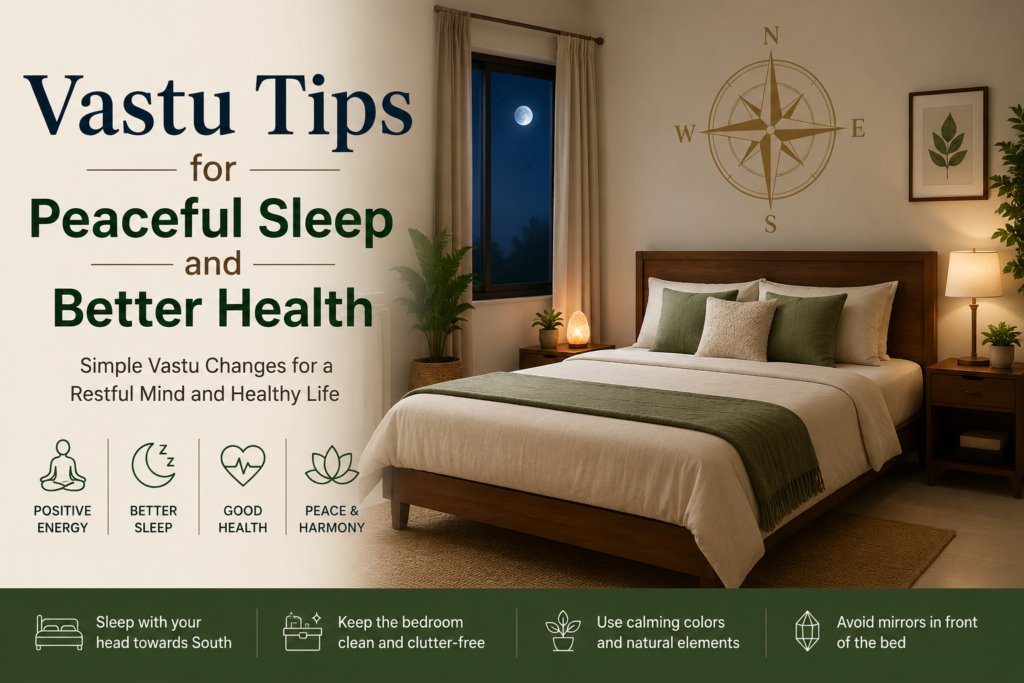
Your bedroom is more than a room — it is an energy field. Ancient Vastu Shastra teaches that the direction you sleep, the placement of your furniture, and the colours on your walls all influence how deeply you rest and how well your body heals itself through the night.
Millions of people across India and the world struggle with restless nights, morning fatigue, and health issues that no amount of medication fully resolves. What many don’t realise is that the spatial energy of their bedroom could be quietly undermining their wellbeing. Vastu Shastra — the 5,000-year-old Indian science of sacred architecture — offers surprisingly practical solutions rooted in the alignment of the human body with the Earth’s magnetic field and the five natural elements.
This guide distils the most effective Vastu tips for peaceful sleep and better health, covering everything from bed direction and room placement to colours, ventilation, and clutter. Whether you are renovating or simply rearranging, these insights can transform your nights.
Why Vastu Matters for Sleep
Sleep is not merely rest — it is when the body repairs tissue, consolidates memory, regulates hormones, and detoxifies the brain. Any energy imbalance in the bedroom creates subtle stress that keeps the nervous system activated even as you lie down. Vastu addresses this by harmonising the room’s orientation with natural electromagnetic flows, ensuring the five elements — earth, water, fire, air, and space — are correctly distributed.
Modern science has independently validated several Vastu principles. Studies on magnetoreception and sleep confirm that sleeping with the head pointing south aligns with the Earth’s magnetic field and can reduce cortisol levels during the night. This is not coincidence — it is ancient empirical observation dressed in the language of nature.
1. The Direction of Your Head While Sleeping
The single most important Vastu rule for sleep is the direction your head faces. The Earth is a giant magnet with the north pole carrying a positive charge and the south pole a negative one. The human body’s own magnetic field, led by the iron-rich blood, works similarly.
South — Best East — Good North — Avoid West — Acceptable
Sleeping with the head towards the south is considered the gold standard in Vastu. It aligns the body’s magnetic poles with the Earth’s, promotes deeper sleep, reduces blood pressure, and supports cardiac health. Sleeping with the head towards the north creates a repelling electromagnetic force, which Vastu links to disturbed sleep, headaches, and long-term health problems.
Sleeping with the head towards the east is particularly beneficial for students and those engaged in mental work — it is associated with enhanced memory, concentration, and a fresh morning energy. West is a neutral direction and acceptable when south or east is not possible due to room layout.
2. The Ideal Bedroom Location in Your Home
The southwest corner of the home is considered the most Vastu-compliant location for the master bedroom. This zone is associated with stability, grounding, and the earth element — all qualities that support restful, uninterrupted sleep. The head of the household sleeping in the southwest corner is believed to feel more in command of their life energy.
Children’s bedrooms are ideally placed in the northwest or west. The northwest zone carries air element energy, which aligns with the dynamic, mobile nature of young minds. The northeast corner is considered sacred and is best left as a prayer or meditation room rather than a sleeping space.
Key insight: Avoid placing any bedroom in the southeast corner. This zone corresponds to the fire element (Agni), and sleeping there may lead to irritability, anger, anxiety, and poor sleep quality over time.
3. Bed Placement and Positioning
Even within the correct bedroom, the position of the bed itself matters enormously. Here are the core Vastu guidelines for bed placement:
Keep distance from walls
Never push the bed flush against the south or east wall. Maintain a small gap of 2–3 inches for energy to flow around you.
Avoid door alignment
The bed should never be placed directly in line with the bedroom door. Sleeping with feet pointing directly at a door is inauspicious.
No mirror facing the bed
Mirrors opposite the bed are one of the most common Vastu faults. They amplify restless energy and can cause disturbed dreams.
No overhead beam
A structural beam running over the sleeping position creates oppressive, stagnant energy. Use a false ceiling to cover it if unavoidable.
4. Colours and Lighting for Better Sleep
Colour profoundly affects the nervous system, and Vastu’s colour recommendations align closely with modern chromotherapy research. The bedroom is a yin space — it should feel cool, soft, and inward-drawing rather than stimulating.
The most Vastu-favourable bedroom colours are muted, earthy tones: pale rose, soft cream, light blue, sage green, and warm beige. These shades calm the mind, lower heart rate, and signal safety to the primal brain. Deep indigo or lavender on a single accent wall is also considered beneficial in Vastu — the colour of Saturn, associated with introspection and deep rest.
Avoid fiery reds, bright oranges, and stark whites in the bedroom. Red activates the sympathetic nervous system; white, while clean, creates a clinical, emotionally sterile environment. Dark, stimulating colours in children’s rooms can also contribute to hyperactivity and irregular sleep cycles.
For lighting, Vastu prescribes warm, amber-toned lighting in the evening — never harsh fluorescents or cool-white LEDs after sunset. A small lamp in the southwest corner of the bedroom is considered grounding and protective.
5. Declutter, Ventilate, and Energise
Clutter is the enemy of Vastu. Stagnant, unused objects trap old energy and prevent prana (life-force) from flowing freely through the room. The area under the bed is especially critical — storing old clothes, boxes, or electronics beneath where you sleep saturates the sleeping aura with heavy, unprocessed energy.
Ensure the bedroom has at least one window that opens to allow fresh air circulation. Cross-ventilation is ideal. Vastu recommends keeping windows in the north or east walls for the best quality of morning air and sunlight. Indoor plants like money plants or peace lilies can be placed in the east or north zone of the room to purify the air, but should not be kept on the south wall as they clash with fire-element energy there.
Electronics — televisions, laptops, routers — generate electromagnetic fields (EMFs) that disturb melatonin production and fragment sleep architecture. Vastu has long recommended keeping such devices out of the bedroom entirely, a guideline now reinforced by sleep science.
6. The Role of the Five Elements
Every Vastu correction for better sleep ultimately traces back to balancing the Pancha Bhutas — the five elements — within the bedroom space. Earth (southwest) provides stability; water (northeast) brings calm; fire (southeast) must be kept minimal; air (northwest) brings movement; and space (centre) ensures openness.
Introducing natural materials — a wooden bed frame, cotton bedding, clay or stone decorative objects — grounds the space in earth energy. Avoiding synthetic fabrics and plastic furniture removes disruptive, non-natural energy from the sleep environment. A small copper vessel filled with water, placed in the northeast corner of the bedroom and changed daily, is a traditional Vastu remedy to activate the water element and promote mental clarity during sleep.
Frequently Asked Questions
Which direction should I sleep as per Vastu for good health?
South is the best sleeping direction as per Vastu Shastra. It aligns your body’s magnetic field with the Earth’s, which is associated with deeper sleep, improved circulation, and better cardiac health. East is the second-best option and is especially recommended for students. Avoid sleeping with your head pointing north, as this is believed to cause disturbed sleep, headaches, and long-term health disturbances.
Which room in the house is best for the bedroom as per Vastu?
The southwest corner of the house is considered the best location for the master bedroom. This zone is governed by the earth element, which provides stability and grounding energy — ideal qualities for restful sleep. Avoid using the southeast corner as a bedroom, since it is governed by the fire element and can cause irritability and poor sleep over time.
Is it bad to have a mirror facing the bed according to Vastu?
Yes. A mirror directly facing the bed is one of the most significant Vastu faults for the bedroom. Vastu holds that mirrors reflect and amplify the sleeper’s energy, creating restlessness, vivid or disturbing dreams, and a general sense of unease. If you cannot remove the mirror, keep it covered at night with a curtain or cloth.
What colour should my bedroom walls be as per Vastu?
Vastu recommends soft, calming tones for bedroom walls — pale rose, light blue, sage green, warm beige, or soft cream. These colours soothe the nervous system and create a receptive environment for deep rest. Avoid bright reds, harsh whites, or dark, saturated colours, which activate the mind and make it harder to wind down at night.
Can electronics in the bedroom affect sleep according to Vastu?
Yes. Vastu has always advised keeping electronic devices out of the bedroom, and this aligns with modern sleep research. Televisions, mobile phones, laptops, and Wi-Fi routers emit electromagnetic fields that suppress melatonin and interfere with the brain’s natural sleep-wake rhythms. At a minimum, place devices away from the bed and switch them to aeroplane mode at night.